
Description
Comprehensive Clinical Diagnostic Reasoning, Laboratory Interpretation & Evidence-Informed Decision-Making for Nurse Practitioners
Author: RISIKATV A. OLAJIDE, MSN, APRN, AANP-BC (ANP, GNP)
Publisher: ALARIS EDUCATIONAL SERVICES
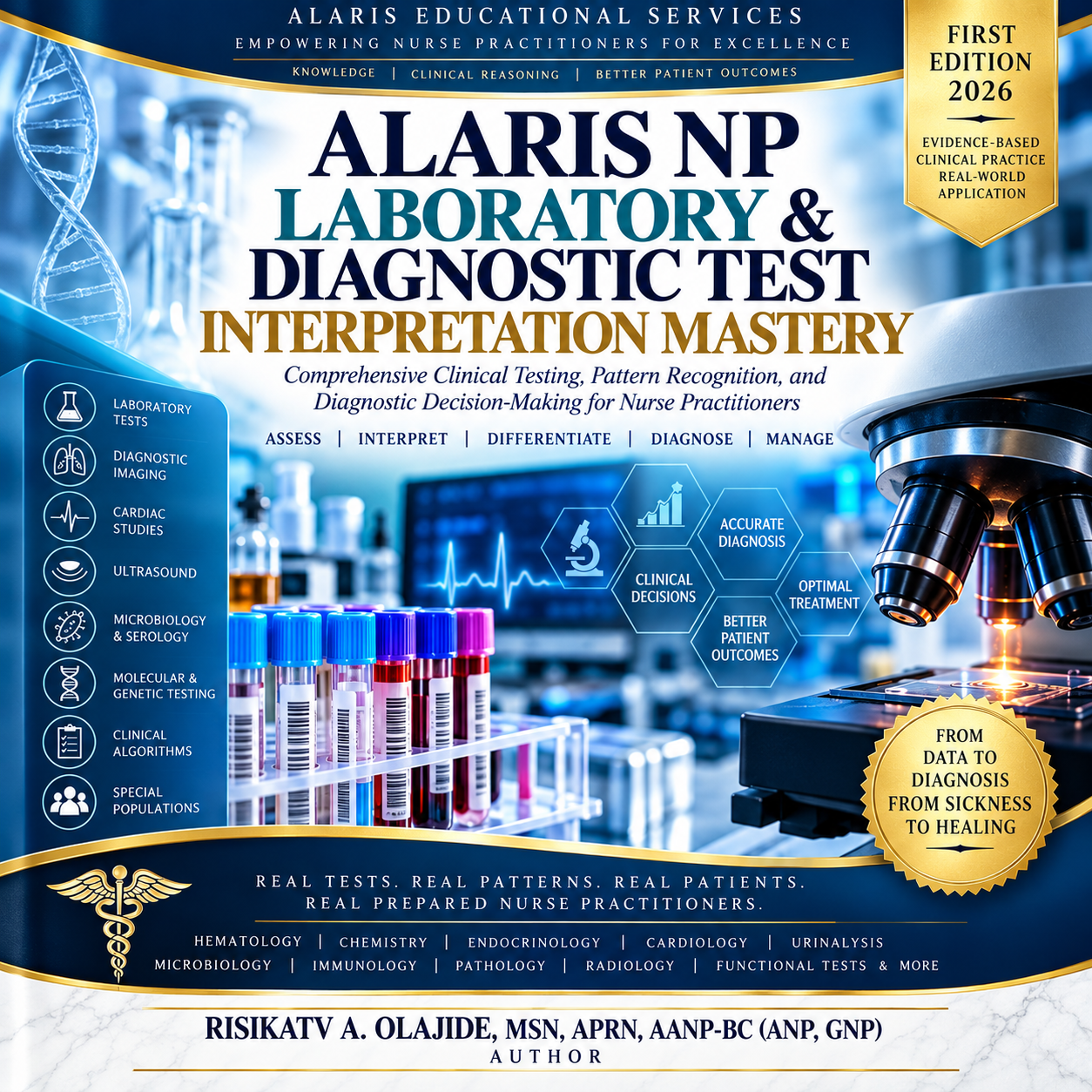
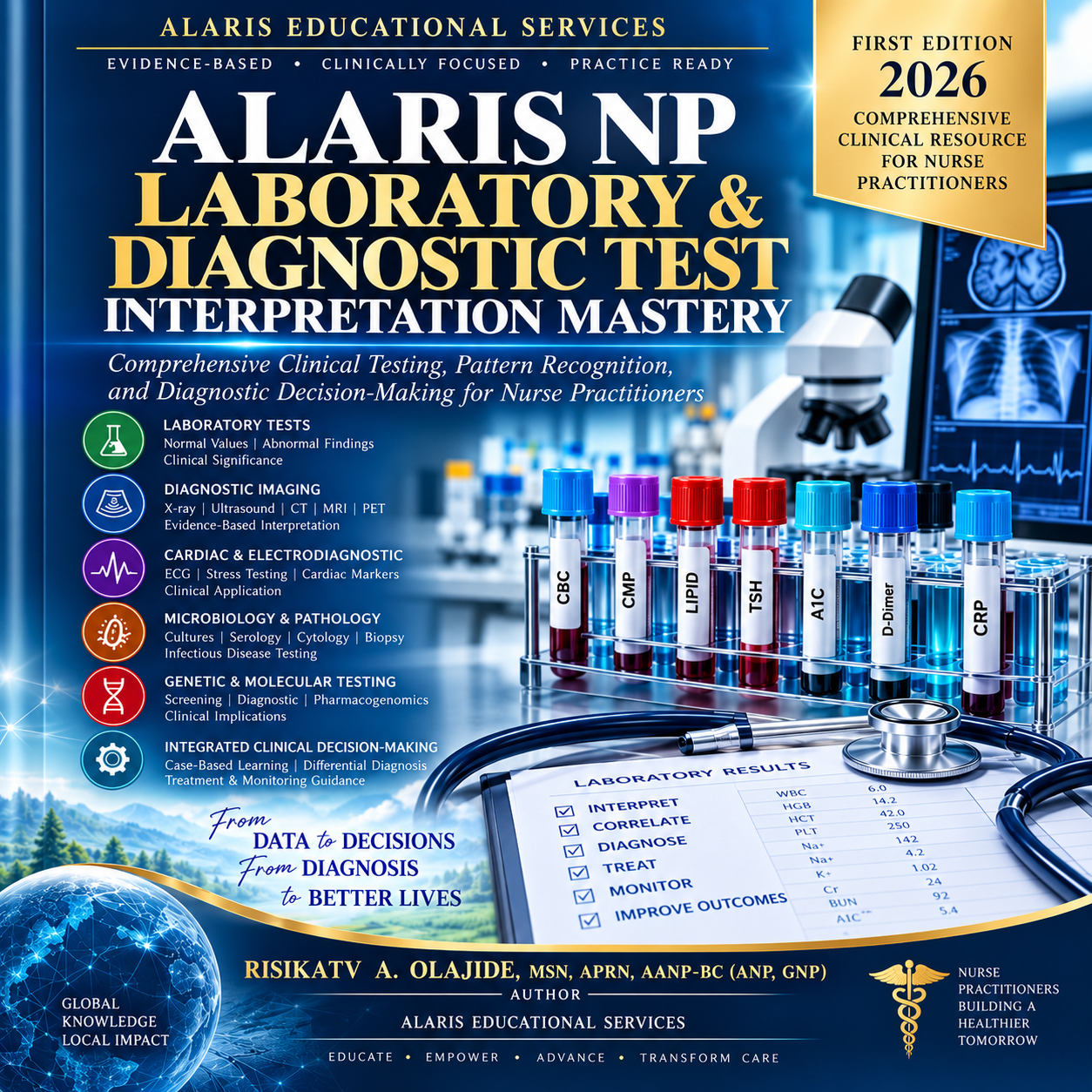
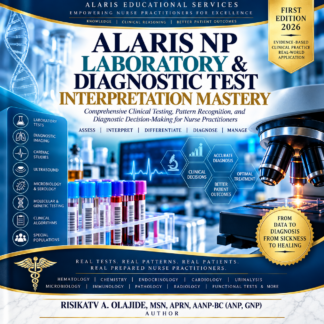
ALARIS NP LABORATORY & DIAGNOSTIC TEST INTERPRETATION MASTERY
A laboratory result is not a diagnosis. A diagnostic study is not a clinical conclusion. The clinician must know how to connect the evidence.
ALARIS NP Laboratory & Diagnostic Test Interpretation Mastery is a comprehensive clinical educational resource designed to strengthen one of the most consequential responsibilities of Nurse Practitioner practice: transforming laboratory findings, diagnostic studies, patient history, physical findings, and clinical presentation into defensible diagnostic reasoning and an appropriate plan of care.
The purpose of this resource is not simply to teach which laboratory values are abnormal. It is designed to teach the clinician to determine:
Why is the abnormality present? What disease processes could produce it? How clinically significant is it? What additional findings support or contradict the suspected diagnosis? What must be investigated next? What dangerous condition cannot safely be missed? What additional or confirmatory testing is appropriate? When is immediate intervention or escalation of care required? And how should the diagnostic evidence change patient management?
This is the distinction between reading a laboratory report and clinically interpreting diagnostic evidence within the context of the patient.
FROM TEST RESULT TO CLINICAL DIAGNOSIS
Diagnostic medicine requires synthesis. No individual laboratory value should automatically be interpreted in isolation from the patient’s history, examination, comorbidities, medications, risk factors, baseline findings, and overall clinical presentation.
A hemoglobin value, for example, cannot be adequately interpreted without considering red-cell indices, reticulocyte response, bleeding history, nutritional status, renal function, inflammatory disease, hemolysis, bone-marrow disorders, medications, age, and the patient’s clinical presentation.
An elevated creatinine cannot simply be treated as an isolated renal number. Interpretation may require evaluation of baseline renal function, estimated glomerular filtration rate (eGFR), urinalysis findings, albuminuria/proteinuria, volume status, medications, hemodynamics, obstruction, acute versus chronic change, electrolyte abnormalities, and associated systemic disease.
Abnormal hepatic studies require recognition of diagnostic patterns rather than simply identifying elevations. Hepatocellular injury, cholestatic abnormalities, impaired synthetic function, medication-related injury, infectious etiologies, metabolic disease, obstruction, and other potential causes must be considered within the complete clinical context.
Endocrine testing requires understanding relationships among regulatory hormones, target-organ responses, feedback mechanisms, disease states, medications, timing, physiologic variation, and the need for appropriate confirmatory testing.
Cardiovascular biomarkers, hematologic studies, coagulation testing, infectious-disease studies, metabolic abnormalities, urinalysis findings, toxicologic studies, inflammatory markers, diagnostic imaging, and other investigations similarly require interpretation within the patient—not interpretation of a number alone.
That patient-centered diagnostic reasoning framework is integrated throughout this resource.
THE CLINICAL REASONING FRAMEWORK
Throughout this resource, diagnostic interpretation is approached through the questions clinicians must answer in actual patient care:
1. What is the patient’s clinical presentation?
Symptoms, history, physical findings, age, comorbidities, medications, risk factors, family history, exposures, and pretest probability establish the diagnostic context.
2. What diagnostic question needs to be answered?
Testing should have a clinical purpose—not simply be ordered because a test exists.
3. Which study is appropriate?
The clinician must distinguish among screening, diagnostic, confirmatory, monitoring, prognostic, and surveillance testing and select the study appropriate to the clinical question.
4. What factors can affect the result?
Interpretation may require consideration of specimen collection, timing, fasting status, medications, hydration, acute illness, physiologic variation, laboratory methodology, and patient-specific factors.
5. Is the finding truly abnormal and clinically significant?
Reference intervals, diagnostic thresholds, baseline values, trends, magnitude of abnormality, and the patient’s clinical condition must be considered.
6. What pattern does the complete diagnostic picture demonstrate?
Its interdisciplinary diagnostic content supports learning across adult, geriatric, family, primary care, acute care, women’s health, reproductive, pediatric, and other advanced-practice clinical environments
7. What to order, why to order it, how to interpret it…
The clinician considers common conditions, competing diagnoses, serious alternatives, and diagnoses that cannot safely be missed.
8. What additional or confirmatory evaluation is required?
An abnormal finding may represent the beginning—not the end—of the diagnostic process.
9. Does the finding require immediate intervention or escalation of care?
Critical abnormalities and dangerous clinical patterns require recognition of when routine outpatient evaluation is no longer appropriate.
10. How does the diagnostic evidence change management?
The ultimate purpose of diagnostic testing is improved clinical decision-making, including treatment, medication decisions, additional evaluation, monitoring, referral, prevention, follow-up, or escalation of care.
COMPREHENSIVE DIAGNOSTIC COVERAGE
This resource extends diagnostic reasoning across major domains encountered by Nurse Practitioners, integrating laboratory medicine with disease recognition and clinical decision-making.
Coverage encompasses major hematologic, renal, genitourinary, electrolyte, acid-base, endocrine, metabolic, hepatic, gastrointestinal, cardiovascular, pulmonary, infectious-disease, immunologic, inflammatory, neurologic, psychiatric, toxicologic, oncologic, women’s-health, reproductive, pediatric, geriatric, genetic/genomic, emergency, primary-care, and population-focused diagnostic considerations, together with clinically relevant diagnostic and imaging principles.
The emphasis is not merely on identifying abnormalities, but on understanding their clinical implications, relationships, diagnostic patterns, and connections to disease processes.
INTERPRETATION BEYOND THE REFERENCE RANGE
An essential principle guides this resource:
“Abnormal” does not automatically mean disease, and “within the reference interval” does not automatically exclude disease.
Appropriate interpretation requires consideration of:
- Clinical presentation and pretest probability
- Patient age and physiologic state
- Baseline and previous results
- Trends and rate of change
- Medication effects and interactions
- Acute versus chronic disease
- Comorbid conditions
- Timing and quality of specimen collection
- Fasting and nutritional status
- Hydration and volume status
- Laboratory methodology and potential interference
- Diagnostic sensitivity and specificity
- Appropriate confirmatory testing
- The complete clinical context
The clinician must interpret the patient represented by the result, not merely whether a value is marked high or low.
DIFFERENTIAL DIAGNOSIS THROUGH DIAGNOSTIC PATTERNS
One of the central goals of ALARIS NP Laboratory & Diagnostic Test Interpretation Mastery is strengthening differential diagnosis.
Rather than teaching learners to associate one laboratory abnormality with one disease, the resource emphasizes pattern recognition, diagnostic discrimination, and clinical synthesis.
The clinician learns to ask:
Which diagnoses explain the complete pattern?
Which diagnosis is most probable in this clinical context?
What dangerous alternative must be excluded?
What finding does not fit the working diagnosis?
What additional study could meaningfully narrow the differential diagnosis?
Is the abnormality primary, secondary, medication-related, transient, physiologic, artifactual, or evidence of systemic disease?
This approach strengthens the transition from academic knowledge to advanced clinical reasoning.
CRITICAL RESULTS, RED FLAGS & ESCALATION OF CARE
Diagnostic mastery also requires recognizing when there is no time for routine follow-up.
The resource emphasizes identification of significant abnormalities and clinical patterns that may indicate severe metabolic disturbance, organ dysfunction, hematologic emergencies, cardiovascular instability, toxicologic emergencies, neurologic disease, acute renal deterioration, serious electrolyte abnormalities, infection, or other potentially dangerous processes.
The clinician must recognize not only what a result means, but also when the result requires immediate reassessment, urgent diagnostic evaluation, emergency intervention, specialist involvement, or escalation to a higher level of care.
That distinction is fundamental to safe advanced-practice care.
DIAGNOSIS MUST LEAD TO CLINICAL ACTION
The resource intentionally connects diagnostic interpretation to management.
Where clinically appropriate, diagnostic findings are related to:
treatment considerations, pharmacologic implications, medication safety, contraindications and precautions, renal and hepatic considerations, monitoring, repeat testing, treatment response, follow-up intervals, patient education, preventive interventions, specialist referral, and escalation of care.
The goal is therefore larger than laboratory competence.
The goal is diagnostic clinical competence.
DESIGNED FOR THE NURSE PRACTITIONER
This resource is designed for:
Nurse Practitioner students developing diagnostic reasoning during graduate education;
NP students in clinical rotations who must connect textbook knowledge with actual patient presentations;
NP certification candidates strengthening clinical interpretation, diagnostic reasoning, and disease differentiation;
Newly practicing Nurse Practitioners developing confidence in diagnostic workups and interpretation;
and experienced Nurse Practitioners seeking a substantial clinical educational reference for reviewing laboratory and diagnostic concepts.
Its interdisciplinary diagnostic content supports learning relevant to adult, geriatric, family, primary-care, acute-care, women’s-health, reproductive, pediatric, and other advanced-practice clinical environments.
MORE THAN LAB VALUES
This resource is not intended to teach clinicians merely to memorize laboratory values.
It is designed to strengthen the reasoning required to determine:
what to order, why to order it, how to interpret it, what can alter the result, which diagnoses the evidence supports, which diagnoses it does not exclude, what must be investigated next, what findings require immediate action, and how diagnostic evidence should change patient management.
ALARIS NP Laboratory & Diagnostic Test Interpretation Mastery was developed around that standard.
Reviews
There are no reviews yet.