
Description
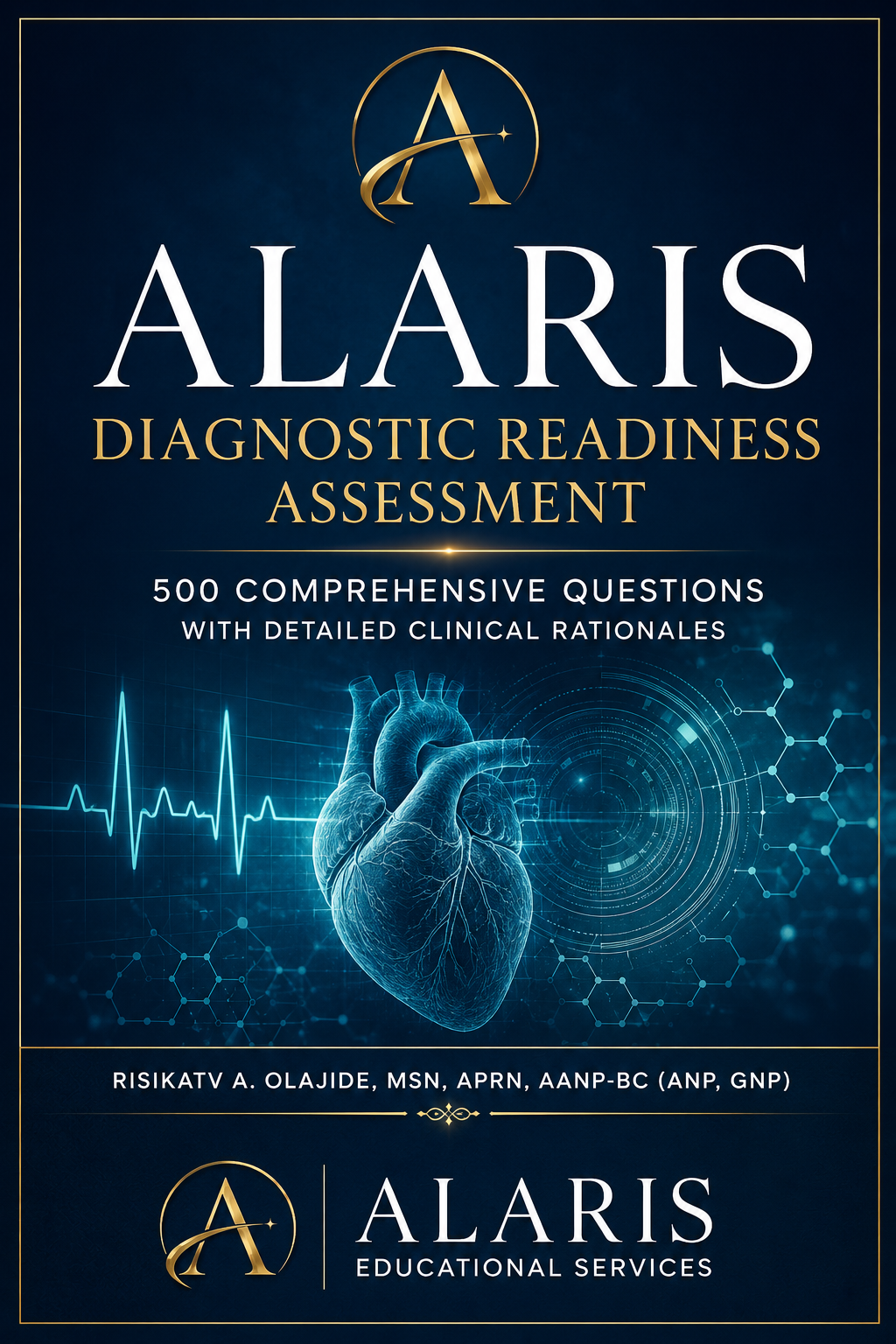
ALARIS DIAGNOSTIC READINESS ASSESSMENT
500 Comprehensive Questions with Detailed Clinical Rationales
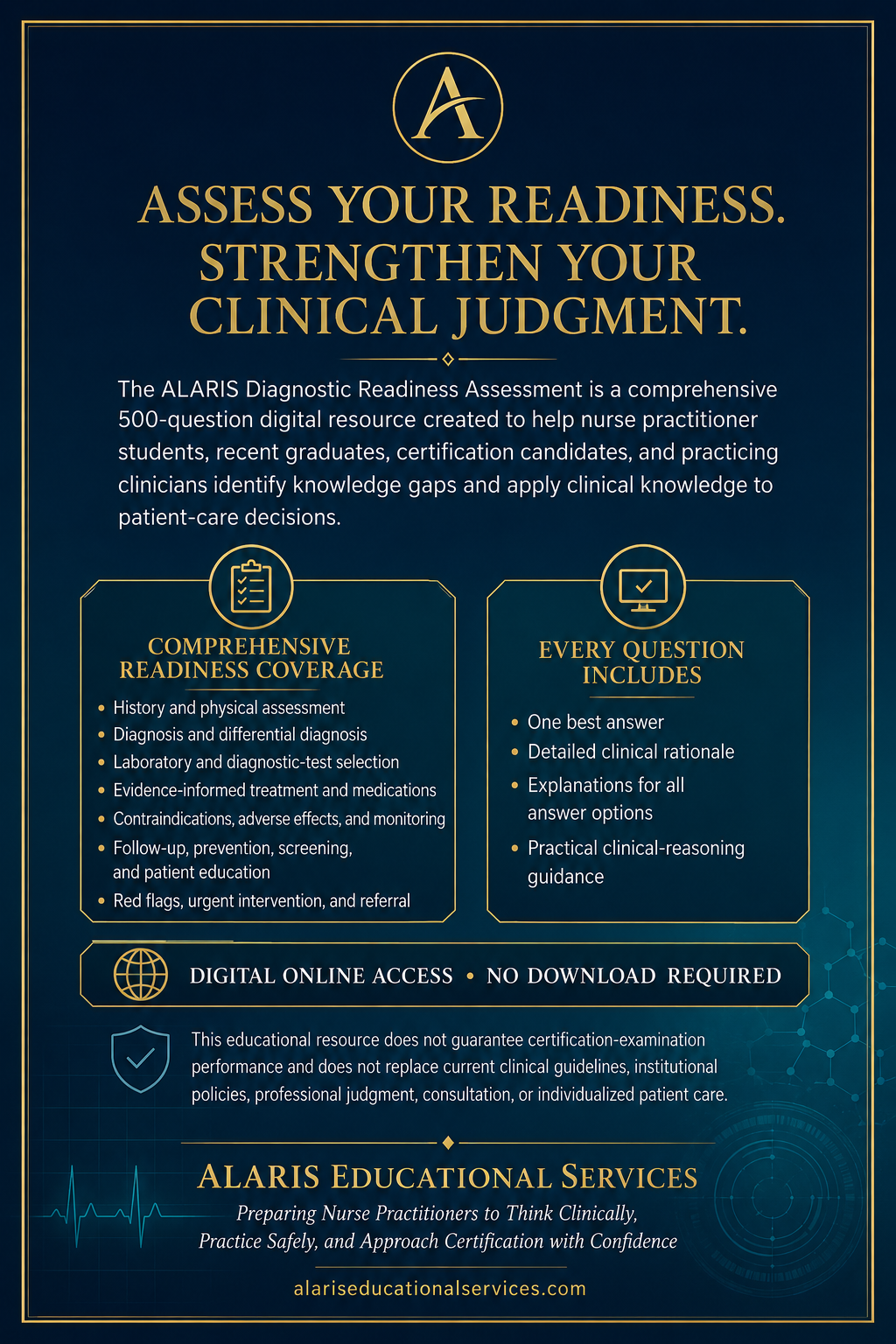
The ALARIS Diagnostic Readiness Assessment is an advanced digital learning and self-assessment resource created for nurse practitioner students, recent graduates, certification candidates, and practicing clinicians who want to strengthen diagnostic reasoning and clinical decision-making.
This comprehensive 500-question assessment goes beyond simple memorization. It challenges students to analyze clinical presentations, recognize significant findings, construct appropriate differential diagnoses, select diagnostic tests, determine evidence-informed treatment strategies, and establish safe monitoring and follow-up plans.
Each question is designed to help the learner think through the clinical encounter—from the patient’s initial presentation to the most appropriate next step in care.
COMPREHENSIVE CLINICAL READINESS COVERAGE
Questions may assess the learner’s ability to:
• Obtain and interpret relevant history and physical examination findings
• Recognize normal, abnormal, and high-risk clinical presentations
• Identify the most likely diagnosis
• Develop and prioritize an appropriate differential diagnosis
• Select laboratory tests, imaging studies, and other diagnostic procedures
• Interpret diagnostic findings within the clinical context
• Choose appropriate first-line and alternative treatment options
• Apply pharmacologic and nonpharmacologic management principles
• Consider medication indications, contraindications, adverse effects, interactions, and monitoring requirements
• Determine appropriate follow-up intervals and treatment-response monitoring
• Provide prevention, screening, counseling, and patient-education recommendations
• Recognize clinical red flags requiring urgent intervention, emergency evaluation, or specialist referral
• Modify care for age, pregnancy status, comorbidities, risk factors, and special populations
• Apply safety principles across the continuum of care
DETAILED CLINICAL RATIONALES
The educational value continues after each question. Detailed clinical rationales reinforce the reasoning required to arrive at the best answer.
Rationales are designed to explain:
• Why the designated answer is the most appropriate choice
• Why the remaining options are less appropriate or incorrect
• The clinical principle being tested
• Important diagnostic and management distinctions
• Relevant treatment and medication considerations
• Safety concerns, contraindications, monitoring, and follow-up
• High-yield lessons that can be applied to future clinical scenarios
This approach transforms every question into a focused clinical learning opportunity—not merely a test of recall.
CLINICAL AREAS REPRESENTED
The assessment integrates content across major areas encountered in nurse practitioner education and practice, including:
• Health promotion, prevention, and screening
• Cardiovascular disorders
• Respiratory disorders
• Endocrine and metabolic disorders
• Gastrointestinal disorders
• Neurologic disorders
• Musculoskeletal disorders
• Dermatologic disorders
• Genitourinary disorders
• Women’s health and reproductive care
• Men’s health
• Pregnancy and maternal health
• Pediatric and adolescent health
• Geriatric care
• Mental health and psychiatric disorders
• Hematologic disorders
• Infectious diseases and immunization
• Ear, nose, throat, and eye disorders
• Pharmacology and safe prescribing
• Professional, legal, ethical, and practice-management principles
WHO SHOULD USE THIS ASSESSMENT?
This resource is designed for:
• Nurse practitioner students preparing for clinical examinations
• Graduates preparing for national certification examinations
• Learners who need to identify knowledge gaps before intensive review
• Students seeking additional practice with diagnosis and differential diagnosis
• Candidates who want to improve clinical reasoning and test-taking confidence
• Practicing clinicians who want a structured review of essential concepts
WHAT MAKES THIS ASSESSMENT DIFFERENT?
The ALARIS Diagnostic Readiness Assessment is readiness-focused. It is designed to reveal not only what the learner remembers, but also how effectively the learner applies clinical knowledge to patient-care decisions.
Rather than relying primarily on isolated facts, the assessment emphasizes the judgment required to answer clinically meaningful questions such as:
• What is the most likely diagnosis?
• Which competing diagnosis must be excluded?
• What is the most appropriate initial diagnostic test?
• What should the clinician do next?
• Which treatment is most appropriate and safest?
• What finding requires urgent intervention or referral?
• What monitoring and follow-up are necessary?
• What education should be provided to the patient?
BENEFITS FOR THE LEARNER
By completing the assessment and carefully reviewing its rationales, students can:
• Identify strengths and areas requiring additional study
• Improve diagnostic reasoning and differential-diagnosis skills
• Strengthen the connection between assessment findings and management decisions
• Practice selecting safe and appropriate treatments
• Reinforce high-yield certification and clinical concepts
• Develop greater confidence when approaching complex patient scenarios
• Create a more focused and efficient study plan
DIGITAL ACCESS
This is a digital, online-access educational product. It is designed for convenient study without the need to download a document. Access is provided according to the option selected at purchase.
The assessment is an educational resource and does not guarantee certification-examination performance. It does not replace current clinical guidelines, institutional policies, professional judgment, consultation, or individualized patient care.
ALARIS EDUCATIONAL SERVICES
Preparing Nurse Practitioners to Think Clinically, Practice Safely, and Approach Certification with Confidence
Reviews
There are no reviews yet.