
Description
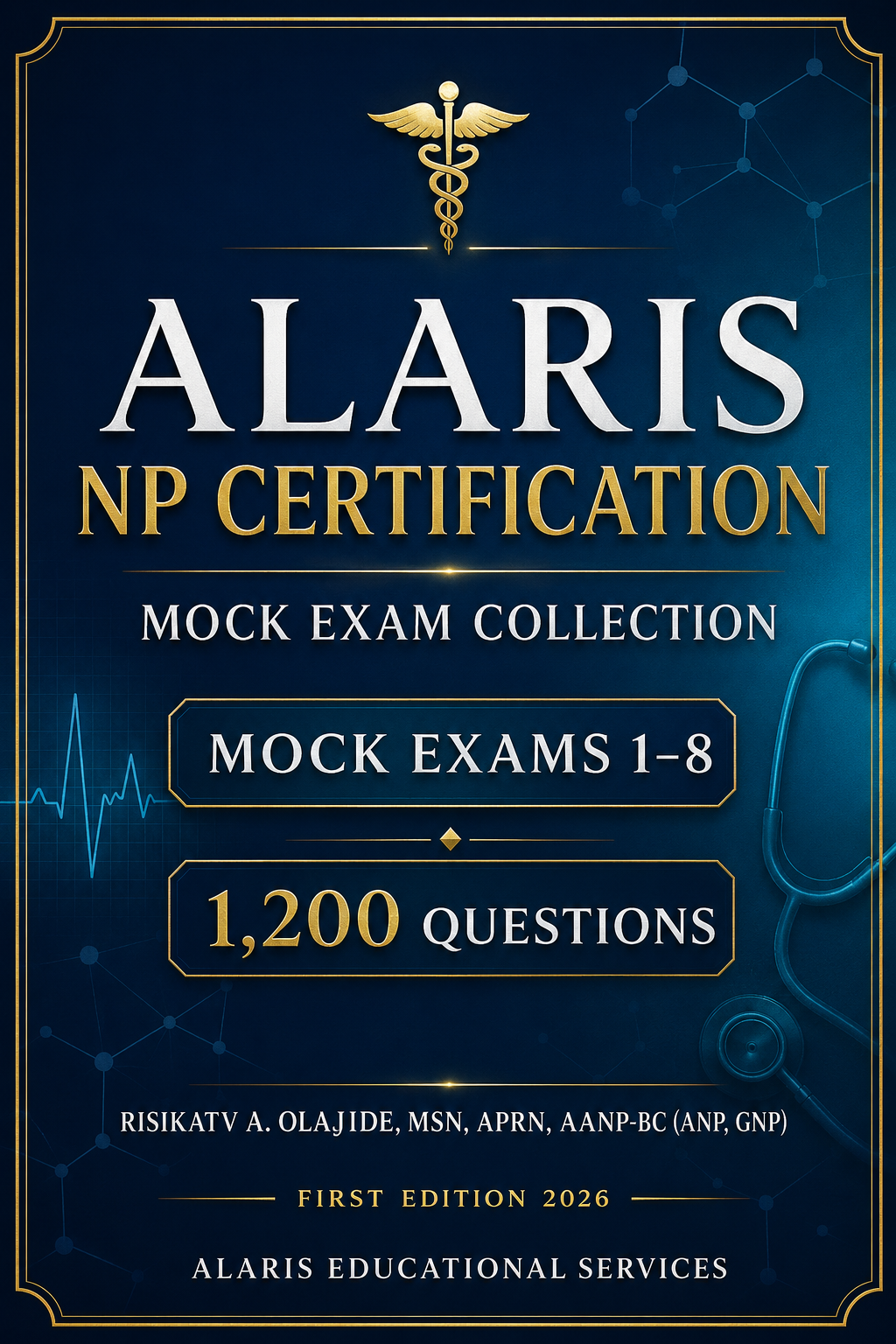
ALARIS NP CERTIFICATION MOCK EXAM COLLECTION
Mock Exams 1–8 | 1,200 Questions with In-Depth Clinical Rationales
Transform certification preparation into meaningful clinical learning.
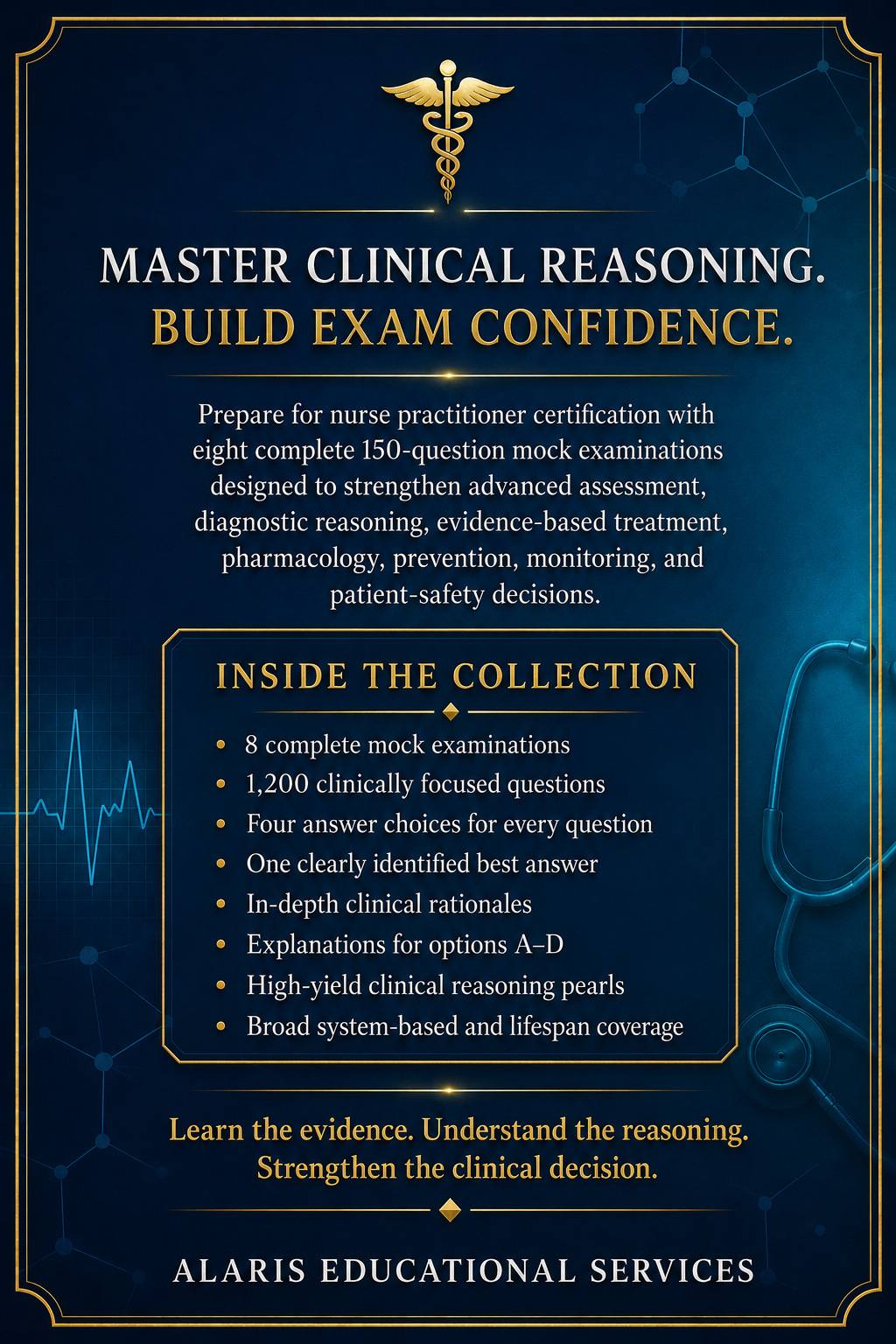
The ALARIS NP Certification Mock Exam Collection is a comprehensive, clinically focused examination resource created to help nurse practitioner students and graduates strengthen the knowledge, judgment, and decision-making skills required for certification preparation and entry-level advanced practice.
The collection includes eight full-length mock examinations, with 150 questions in each exam—a total of 1,200 carefully structured clinical questions. Each examination challenges learners to interpret patient findings, recognize diagnostic patterns, prioritize competing clinical concerns, and identify the safest and most appropriate course of action.
These are not questions designed for memorization alone. They are clinical learning encounters that guide students through the essential stages of patient care: assessment, diagnosis, planning, treatment, monitoring, and evaluation.
CLINICAL REASONING THROUGH REALISTIC PATIENT PRESENTATIONS
Questions are presented through clinically meaningful scenarios that require the learner to evaluate patient history, symptoms, physical examination findings, comorbidities, laboratory results, imaging findings, medications, risk factors, and changes in clinical status.
Students practice how to:
• Identify the most clinically significant information in a patient presentation
• Distinguish expected findings from warning signs and medical emergencies
• Formulate and prioritize differential diagnoses
• Determine the most likely diagnosis
• Select appropriate screening and diagnostic studies
• Interpret common laboratory and diagnostic findings
• Choose the safest evidence-informed treatment strategy
• Evaluate therapeutic effectiveness and disease progression
• Determine appropriate follow-up intervals
• Recognize when consultation, referral, hospitalization, or emergency intervention is required
COMPREHENSIVE TREATMENT AND MANAGEMENT REVIEW
The collection reinforces both pharmacologic and nonpharmacologic management of common, complex, and high-risk conditions encountered in primary care.
Treatment-focused questions help students examine:
• First-line and alternative treatment options
• Treatment selection based on clinical presentation and patient characteristics
• Lifestyle and behavioral interventions
• Acute and chronic disease management
• Management of comorbid and interacting conditions
• Contraindications and treatment precautions
• Therapeutic goals and expected clinical response
• Laboratory and clinical monitoring requirements
• Treatment failure and escalation of care
• Patient-centered education and shared decision-making
• Interprofessional collaboration and referral
CLINICALLY MEANINGFUL PHARMACOLOGY
Medication-related questions extend beyond identifying a drug name. Students are challenged to apply pharmacologic knowledge to individual patient circumstances and make safe prescribing decisions.
Medication content addresses:
• Therapeutic indications and appropriate medication selection
• Mechanisms of action when clinically relevant
• First-line, alternative, and adjunctive therapies
• Contraindications and precautions
• Common and serious adverse effects
• Drug–drug and drug–disease interactions
• Renal, hepatic, pregnancy, lactation, and age-related considerations
• Baseline assessment before initiating therapy
• Laboratory and clinical monitoring
• Medication adherence and patient counseling
• Recognition of toxicity and serious adverse reactions
• Evaluation of treatment effectiveness
• Safe modification, escalation, or discontinuation of therapy
This approach helps learners connect pharmacology with pathophysiology, diagnostic reasoning, patient safety, and real-world clinical management.
DETAILED RATIONALES THAT TEACH
Every question is followed by the correct answer and an in-depth clinical rationale. The rationale explains the reasoning behind the best response and reinforces the clinical principles necessary to manage similar presentations.
Individual explanations for answer choices A, B, C, and D help students understand:
• Why the correct response is the best clinical decision
• Why the remaining options are less appropriate
• When an incorrect option might become appropriate in a different clinical situation
• Which findings distinguish closely related diagnoses
• Which common distractors can lead to examination errors
• How to prioritize safety, urgency, and the next best step
Selected questions also include clinical reasoning pearls that highlight high-yield distinctions, diagnostic clues, medication precautions, red flags, and practical approaches to certification-style questions.
BROAD SYSTEM-BASED AND LIFESPAN COVERAGE
The eight examinations integrate patient care across the lifespan, including pediatric, adolescent, adult, reproductive, pregnancy-related, and geriatric considerations.
Clinical content encompasses:
• Health promotion, risk reduction, and preventive screening
• Cardiovascular disorders
• Respiratory disorders
• Gastrointestinal and hepatic disorders
• Endocrine and metabolic disorders
• Neurologic disorders
• Musculoskeletal and rheumatologic disorders
• Hematologic disorders
• Dermatologic conditions
• Genitourinary disorders
• Women’s and men’s health
• Pregnancy and maternal health
• Mental health and psychiatric disorders
• Infectious diseases and immunization
• Ear, nose, throat, and eye disorders
• Pediatrics and adolescent health
• Geriatric assessment and management
• Pharmacology and safe prescribing
• Professional, ethical, legal, and practice-related concepts
A COMPLETE LEARNING AND EXAMINATION-PRACTICE SYSTEM
The collection may be used in several ways:
• Complete each mock exam under timed testing conditions
• Review one examination at a time during structured study
• Identify strengths and persistent knowledge gaps
• Examine patterns behind missed questions
• Reinforce weak clinical systems through rationale-based review
• Practice prioritization and next-step decision-making
• Build endurance for a 150-question examination
• Conduct a final comprehensive review before certification testing
Students gain the greatest benefit by answering each question independently before reading the rationale, reviewing the explanation for every option, and recording the clinical principle responsible for each missed answer.
WHAT STUDENTS RECEIVE
• Eight complete mock examinations
• 150 questions in each examination
• 1,200 clinically focused questions in total
• Four answer choices for every question
• One clearly identified best answer
• In-depth clinical rationales
• Individual explanations for options A–D
• Clinical reasoning and patient-safety guidance
• High-yield clinical pearls
• Broad system-based and lifespan coverage
• Extensive treatment and medication-management review
The ALARIS NP Certification Mock Exam Collection is more than a set of practice examinations. It is an expansive clinical-learning resource designed to help students integrate advanced assessment, pathophysiology, diagnostic reasoning, therapeutics, pharmacology, preventive care, monitoring, and outcome evaluation.
Every missed question becomes an opportunity to correct a knowledge gap. Every rationale becomes a focused clinical lesson. Every mock examination helps the learner progress toward safer reasoning, stronger judgment, and greater confidence.
Learn the evidence. Understand the reasoning. Strengthen the clinical decision.
First Edition 2026
ALARIS EDUCATIONAL SERVICES
Reviews
There are no reviews yet.